






Products
warning : We would like to remind our users that the Medspiration data products are still experimental. We ask our users to remember that the system is not yet fully tuned and we do not expect our SST products necessarily to be achieving the highest quality. For example we are still relying on static sensor specific error statistics (SSES) because the GHRSST IPO is not able to supply dynamically updated SSES until the matchup data base (MDB) is sufficiently populated. Thus the SSES attached to L2P products may not be as well refined as we intend for the operational phase of Medspiration. We are also taking a very cautious approach to the estimation of diurnal warming in the evaluation of SST foundation temperature. Thus the L4 (Beta) product should not yet be considered to provide a fully reliable SST map of the Mediterranean Sea.More information on the GHRSST-PP product specification, which Medspiration complies to, can be found in the GHRSST-PP Product User Guide.
L2P Sea Surface Temperature
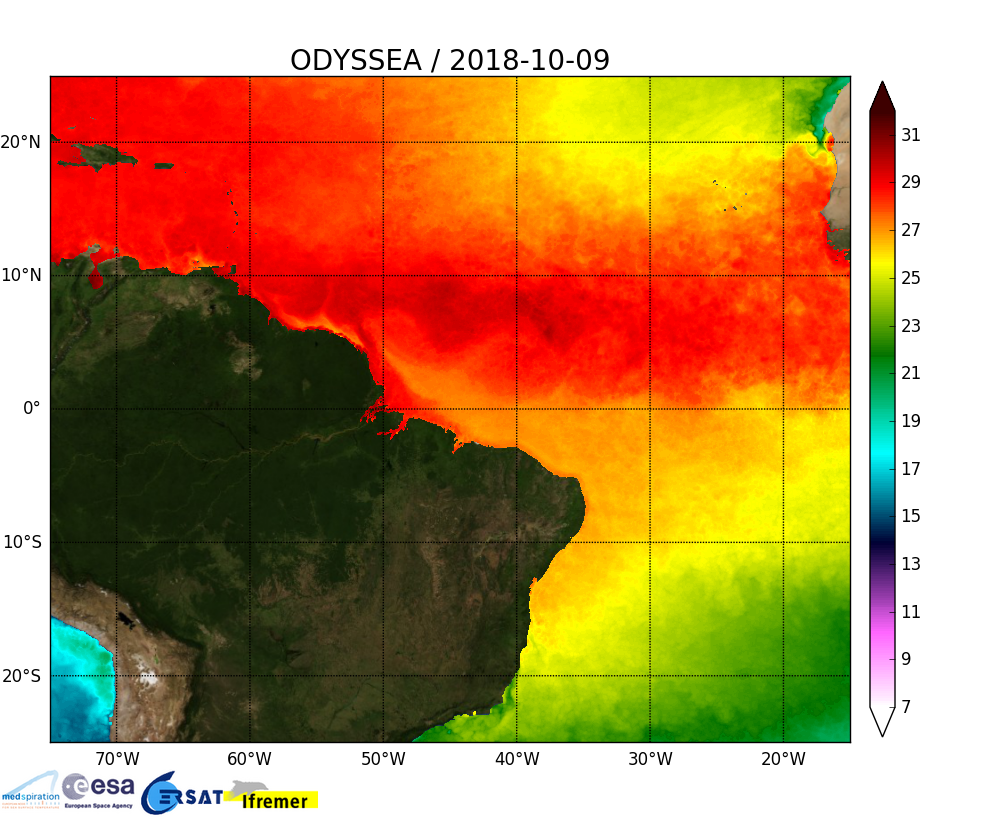
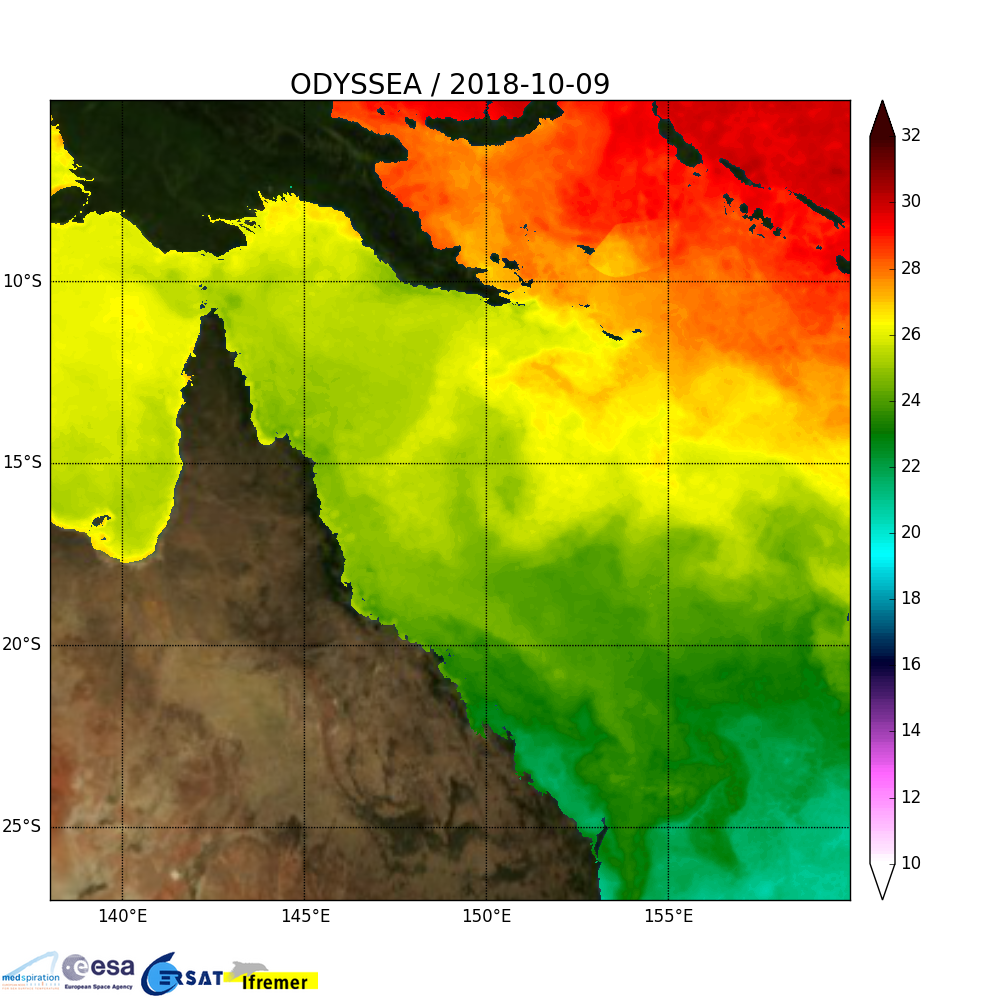
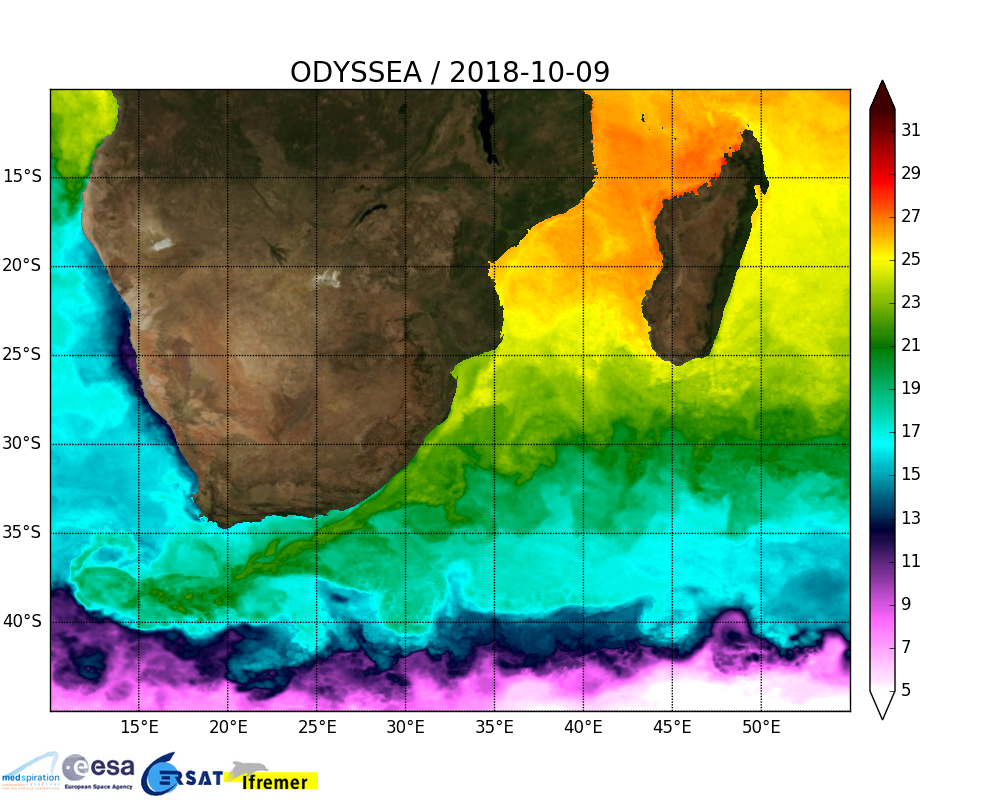
L2P SST products for the European RDAC area which spans from 70S to 90N (to the ice limit) and from 100W to 45E and contains the whole Atlantic and the adjacent European seas (see Figure 1). Parts of the Pacific Ocean within these limits are expressly excluded. L2P products consist of the L2 SST data in their native sampling grid as ingested, with the addition of a quantitative confidence value attached to every data point. The confidence value will be based on the sensor specific error statistics (SSES) to be supplied by GHRSST-PP. and ancillary data such as wind speed and solar radiation, which can influence the diurnal variability of SST. The L2P data will be provided in near-real time to the GHRSST-PP GDAC and to selected operational users in Europe for assimilation into ocean forecasting models. They will also be archived and served widely to general European users.
![]() |
Figure 1 |
The available L2P products are listed below :
| Product | Satellite/Sensor | Original provider | Resolution | Coverage |
|---|---|---|---|---|
| ATS_NR_2P | ENVISAT/AATSR | ESA | 1 km | Atlantic (incl.Mediterranean) |
| AVHRR16_G AVHRR17_G |
NOAA16/AVHRR NOAA17/AVHRR |
PO.DAAC | 9 km | Atlantic (incl.Mediterranean) |
| AVHRR16_L AVHRR17_L |
NOAA16/AVHRR NOAA17/AVHRR |
PO.DAAC | 1-2 km | Eastern Mediterranean |
| NAR16_G NAR17_G |
NOAA16/AVHRR NOAA17/AVHRR |
O&SI SAF | 1-2 km | Mediterranean |
| SEVIRI_SST | MSG/SEVIRI | O&SI SAF | 10 km | Atlantic (incl.Mediterranean) |
| AMSRE | AQUA/AMSRE | REMSS | 25 km | Atlantic (incl.Mediterranean) |
| TMI | TRMM/TMI | REMSS | 25 km | Atlantic (incl.Mediterranean) |
L4 Sea Surface Temperature
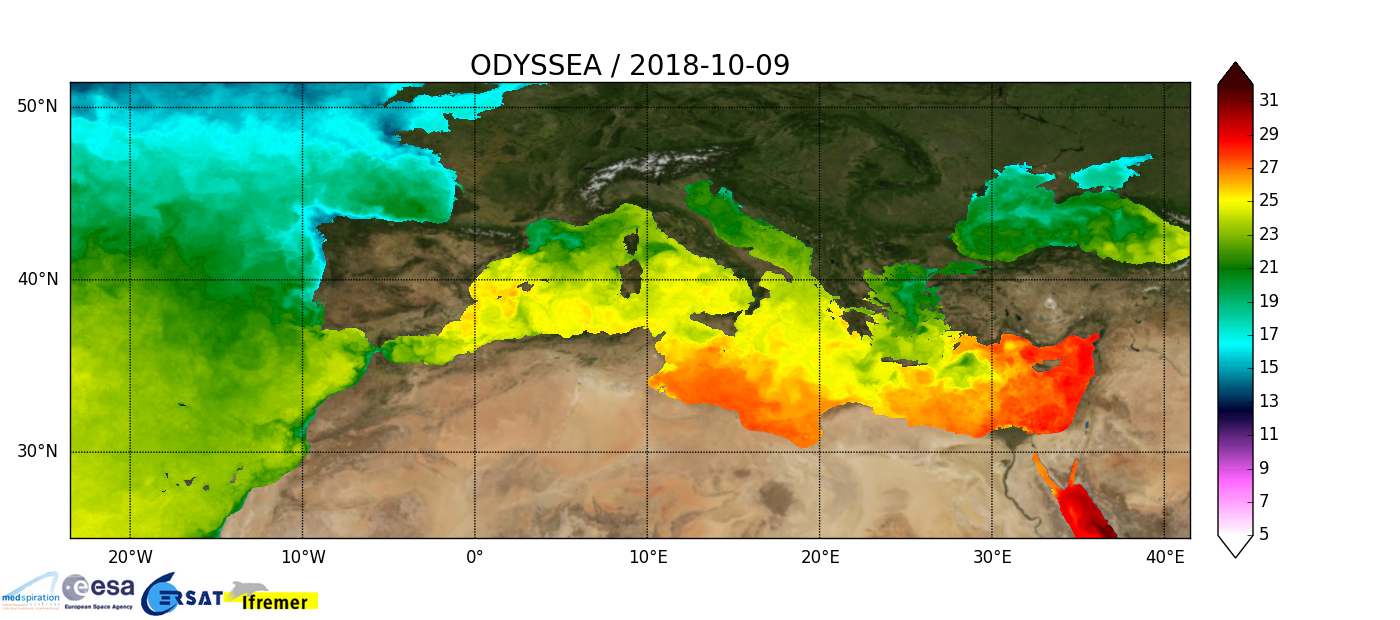
A L4 SST product will be produced at ultra-high resolution (UHR) on a 2 x 2 km grid for the Mediterranean Sea (see Figure 2). Optimal interpolation (OI) techniques will be used to combine coincident L2P measures of SST from different types of sensor and to fill gaps where no observations are available. Whereas L2P data essentially represent the skin or sub-skin SST, the L4 SST product is defined to represent SSTfnd and is updated only once every 24 hr. Using GHRSST-provided parameterisations of the skin layer and diurnal thermocline thermal structure, L2P products will be converted to SSTfnd before applying OI. The L4 product also contains an estimate of the skin temperature and its diurnal variation derived from the analysed SSTfnd.
![]() |
Figure 2 |
Note : on ESA request, we keep all the processing logs of each product distributed. These logs may be requested to the Medspiration Help Desk (fpaf@ifremer.fr) if you are interested in.
Matchup database
Available in situ measurements of SST will be matched with coincident samples within the L2P SST data, in order to prepare records for delivery to the GHRSST-PP MDB. This is required by GHRSST-PP to determine the SSES needed when assigning quality values for the L2P data. The geographical scope of the MDB records to be delivered is the same European area as defined for the L2P products.
Diagnostic Data Sets
Entries to the GHRSST-PP high resolution diagnostic data set (GHRSST HR-DDS) will be compiled by extracting, and resampling onto a 0.01° grid, full resolution sub scenes for a set of predefined small areas (typically 2° x 2°) from every L2P SST and L4 dataset generated by the Medspiration processor. The HR-DDS sites are defined by GHRSST-PP. The purpose of the HR-DDS is to allow intercomparison of the characteristics of the SST derived from different sensor types, in order to facilitate the research needed to test and improve the data merging methods used in GHRSST-PP.